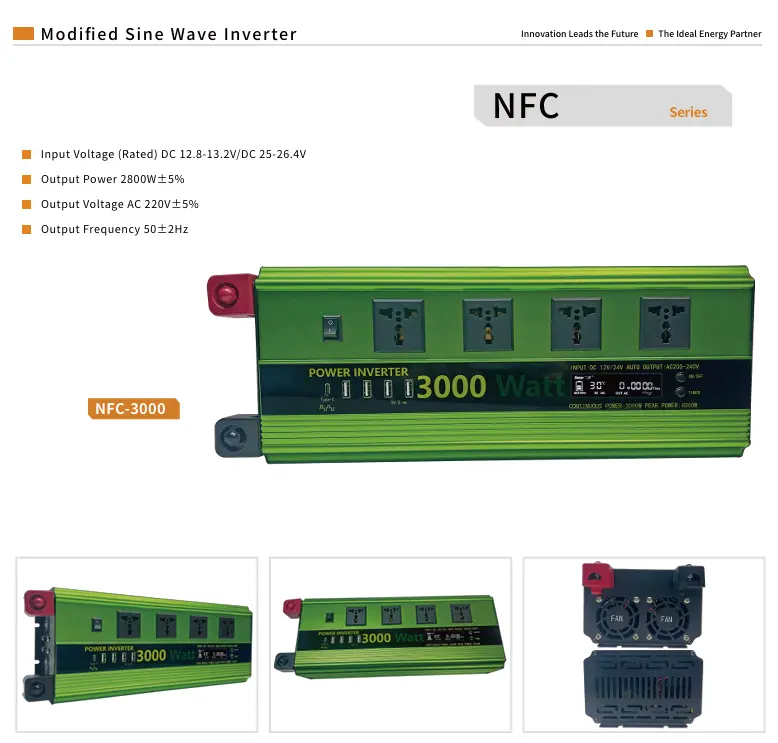
When a solar backup project needs more AC capacity than a compact household kit, a 3000W inverter becomes a common selection point. The NFC-3000 type inverter is suitable for distributors and project buyers who need a stronger backup power option for small shops, field sites, work cabins, service vehicles, and battery-based emergency power systems.
Where a 3000W Inverter Fits
A 3000W inverter should be selected for systems where the load list is already clear. It can support more demanding applications than entry-level inverter models, but it also requires better planning on the DC side. Battery capacity, cable size, fuse selection, ventilation, and installation space should all be confirmed before final quotation.
For wholesale buyers, this model can be positioned as a higher-capacity inverter for customers who need more usable AC output but are not yet moving into a full hybrid inverter system. That makes it useful for catalog expansion and project-based solar backup packages.
Battery Bank and Current Planning
Higher inverter power means higher battery current. The battery bank should be sized not only for runtime, but also for safe discharge current. If the battery, cable, or protection devices are undersized, the system may experience voltage drop, heating, or early low-voltage shutdown under heavy load.
- Confirm continuous wattage and starting surge for the expected equipment.
- Match battery capacity to both current demand and required backup hours.
- Use suitable DC cable, fuse protection, and installation spacing.
Solar Controller and Panel Matching
In solar backup systems, inverter capacity should be matched with the solar charge controller and panel array. A larger inverter does not automatically improve daily usability if the solar charging side cannot recover the battery in time. For remote sites and unstable-grid regions, balanced charging design is often more important than simply increasing inverter wattage.
When preparing a B2B offer, it is helpful to provide a complete system suggestion: inverter model, battery bank range, controller current, solar panel capacity, cable recommendation, and typical supported loads. This makes the NFC-3000 easier for dealers and installers to explain to end users.
Procurement Value
The NFC-3000 can serve as a practical upper-step product in a solar inverter range. It gives distributors a stronger option for customers who need more output capacity while still requiring clear installation guidance, stable battery matching, and a manageable solar backup system design.